Guide / Electrical
Replace an outlet safely.
Swapping a worn or cosmetically-damaged outlet is a standard 15-minute job — if you actually shut off the breaker and actually test for voltage. Every step matters.
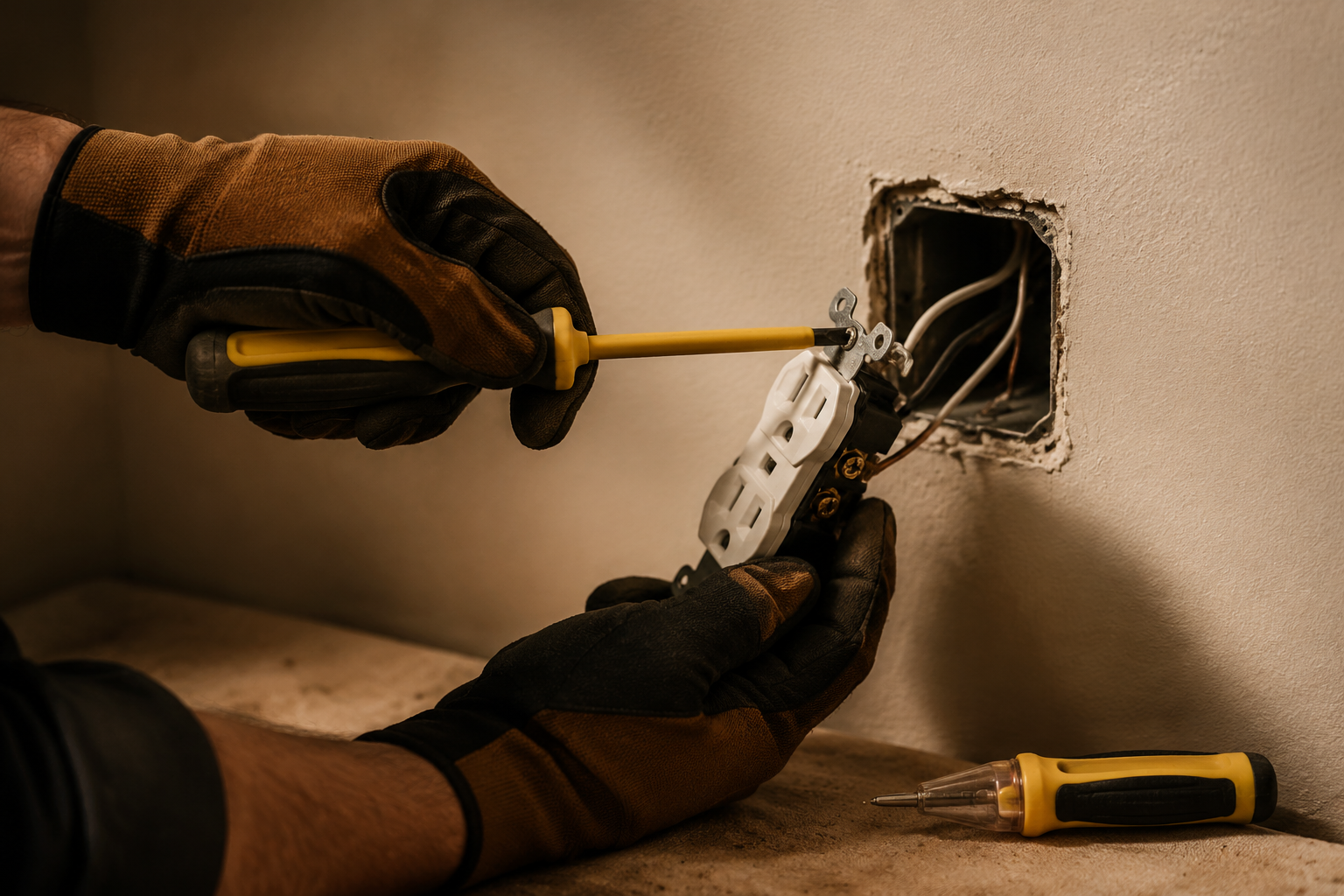
You’ll need.
- Insulated Phillips and slotted screwdrivers
- Non-contact voltage tester
- Digital multimeter
- Replacement outlet (matching voltage / amperage rating)
- Wire stripper (if cutting back damaged wire ends)
Time: 15–25 minutes
From kit: Electrical Repair Kit (A-03)
Steps.
Identify the breaker.
Turn off the breaker that controls the outlet. Test the outlet with a plug-in lamp to confirm it’s dead. Tape over the breaker so no one flips it back on while you work.
Test twice with two testers.
Non-contact tester first (held near the outlet face — no beep / no light = no live wire detected). Then unscrew the face plate, pull the outlet partially out, test the wire terminals with the multimeter set to AC voltage. Reading should be zero. Never skip this step.
Photograph the wiring.
Before you disconnect anything, take a phone photo of the existing wiring. Note which color goes to which terminal.
Disconnect the old outlet.
Unscrew each wire terminal. Pull each wire free. If the wire ends are blackened or damaged, cut them back ~1cm and re-strip with the wire stripper to ~10mm of bare copper.
Connect the new outlet.
Match the photo: black (hot/live) to the brass terminal, white (neutral) to the silver terminal, green or bare (ground) to the green terminal. Wrap each wire clockwise around its screw and tighten. Tug on each wire to verify it can’t pull free.
Re-mount and test.
Push the new outlet back into the box (don’t crush the wires — fold them in carefully). Screw the outlet to the box. Re-mount the face plate. Turn the breaker back on. Test with a plug-in lamp. Test with a plug-in outlet tester (the three-light kind) to verify wiring is correct.